What challenges should designers face now, as found at the GOOD DESIGN AWARDs.
FOCUSED ISSUES is a GOOD DESIGN AWARD initiative that depicts the future of design in society through the screening process.
FOCUSED ISSUES 2025
Considering “FOCUSED ISSUES 2025”
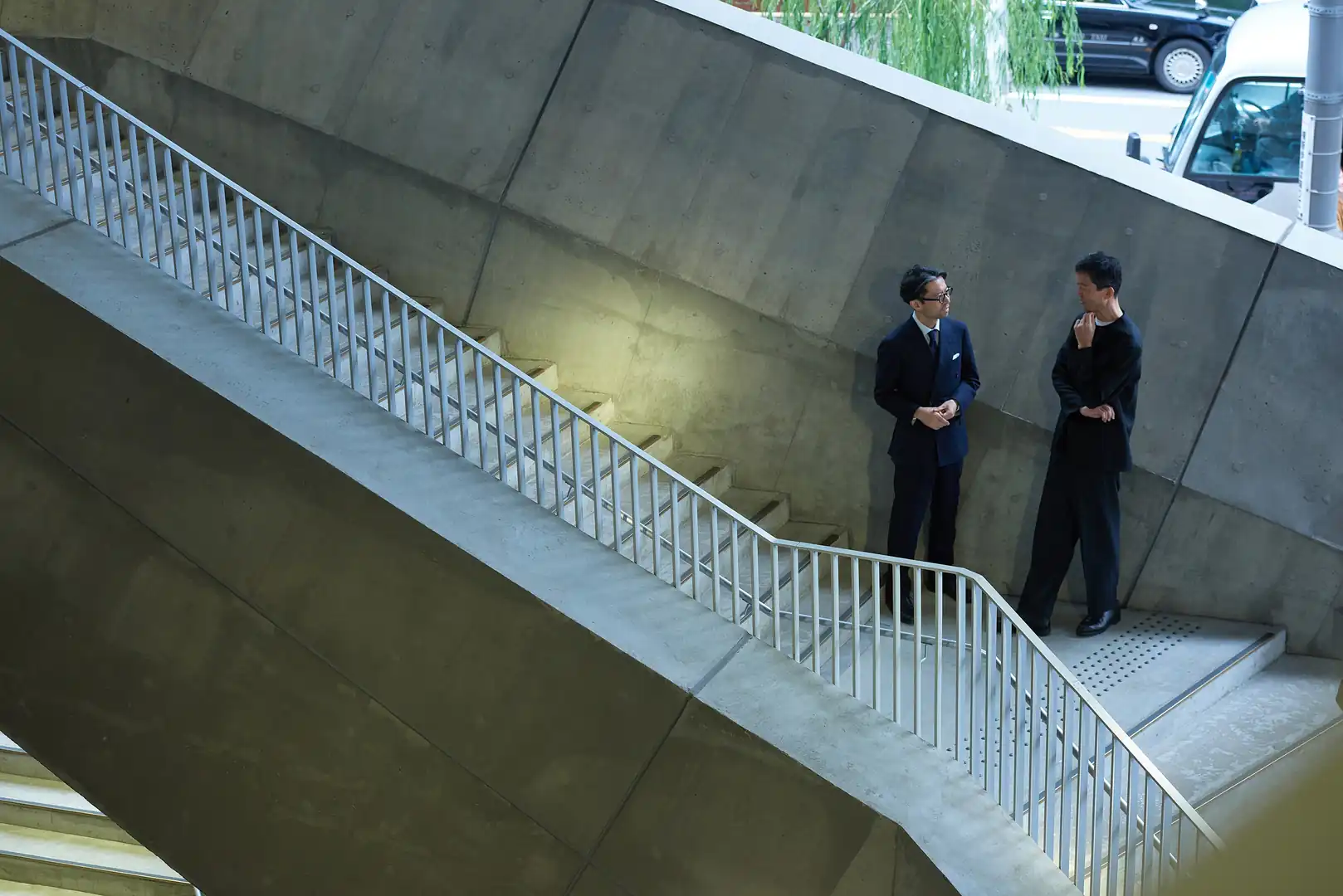
Design of “blank space” given shape in Ginza - Daisuke Nagano of Ginza Sony Park Project talks with anthropologist Yutaka Nakamura
2026.2.20
Focused Issues is an activity that considers and recommends new possibilities for design through the Good Design Award screening process. In advance of the announcement of the 2025 GOOD DESIGN AWARD Focused Issues, this article gives a sneak peek at the conversations which took place as part of this process.
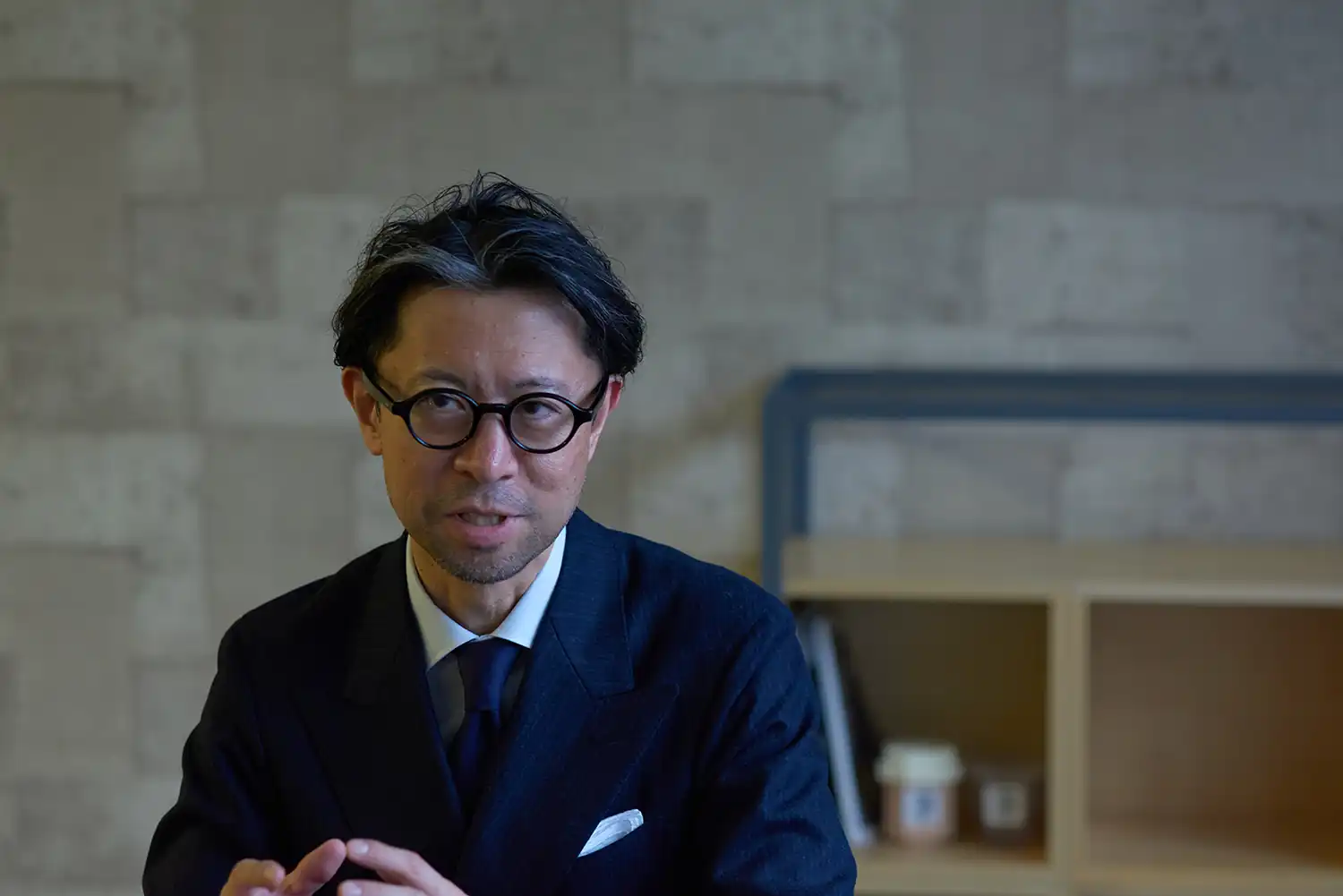
In devising his proposal, Focused Issues Researcher and anthropologist Yutaka Nakamura was inspired by the Ginza Sony Park Project, a GOOD DESIGN GOLD AWARD recipient.
After the Sony Building, long a familiar site in Ginza, was demolished, it was opened up as a flat park, the Ginza Sony Park (2019 GOOD DESIGN GOLD AWARD winner), before a new building less than half the height specified in the district plan was built. This self-conscious “blank space” is said to have created a “cool” aesthetic that has been cultivated in Ginza’s streets and the “rhythm” that colors the area.
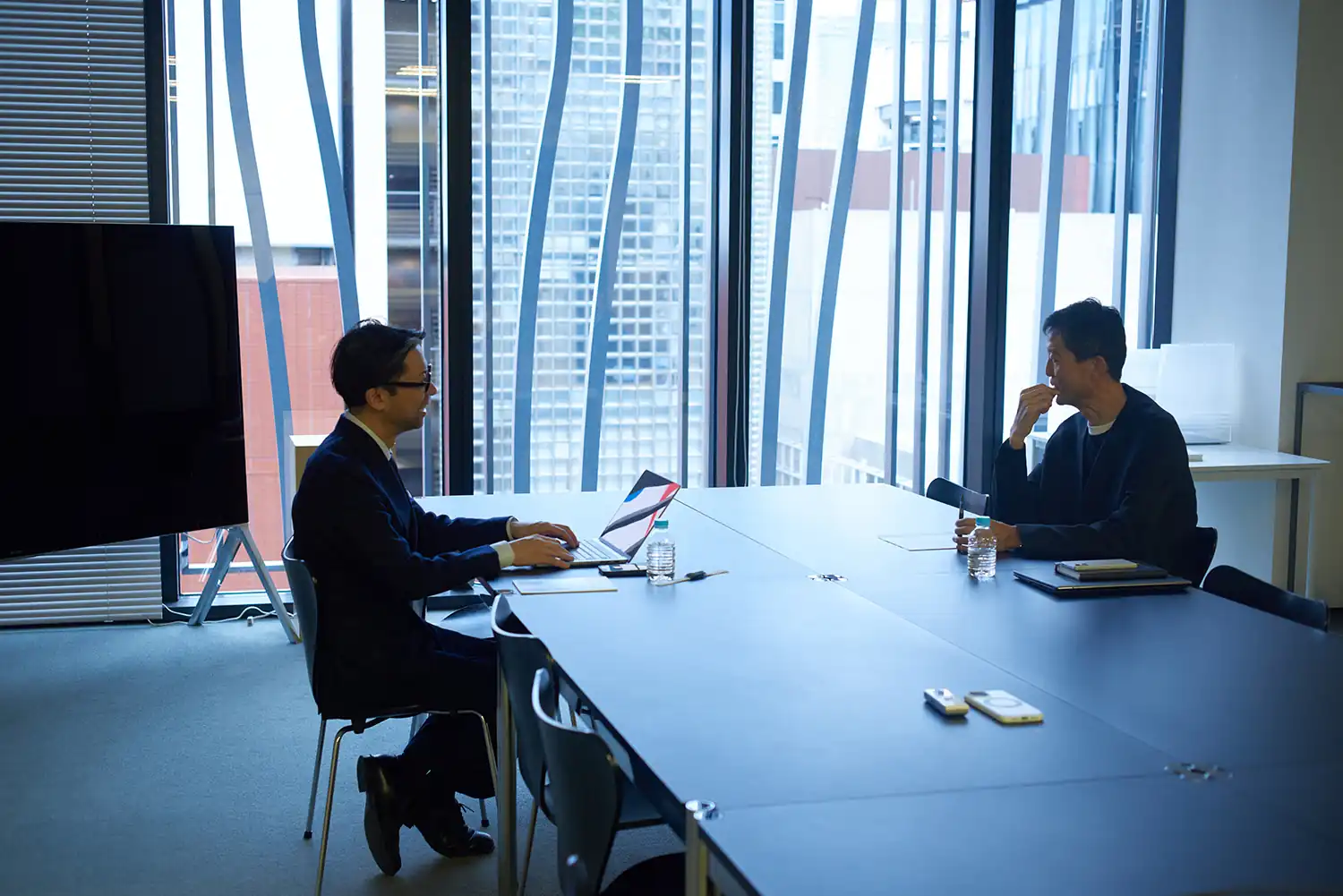
Nakamura spoke with Daisuke Nagano, President and Chief Branding Officer of Sony Enterprise Co., Ltd., who led the project, about this process and the site at present.
The “symbol” of Sony. Search for a Sony-like design; decision to rebuild
Nakamura Ginza Sony Park was awarded a GOOD DESIGN GOLD AWARD for Phase 1 in 2019; Phase 2 brought it to completion, and the project as a whole was awarded a GOOD DESIGN GOLD AWARD in 2025. I think it must have been quite difficult to build a building with so much blank space in a prime location in Ginza. What was the background leading up to this project in the first place?
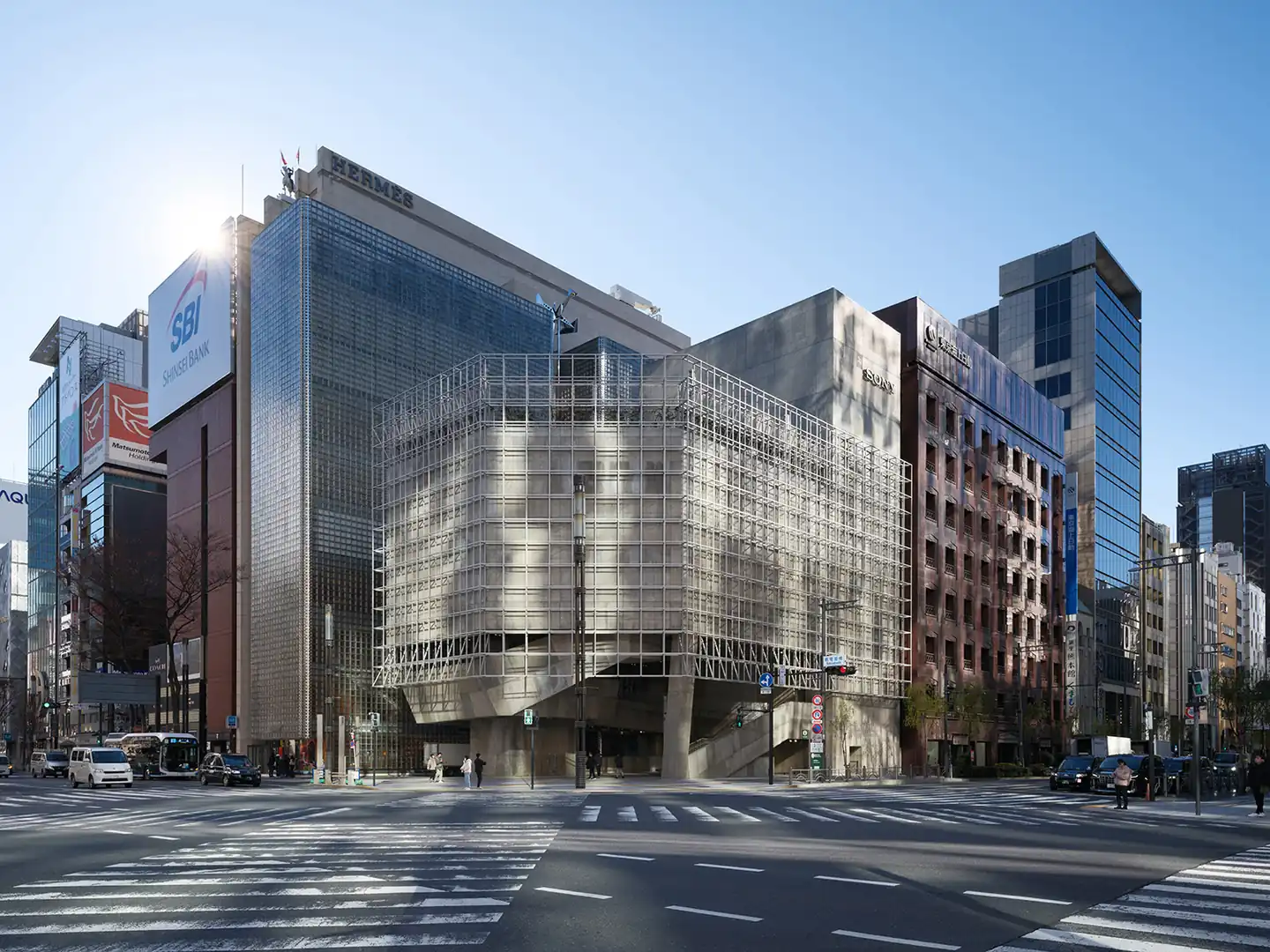
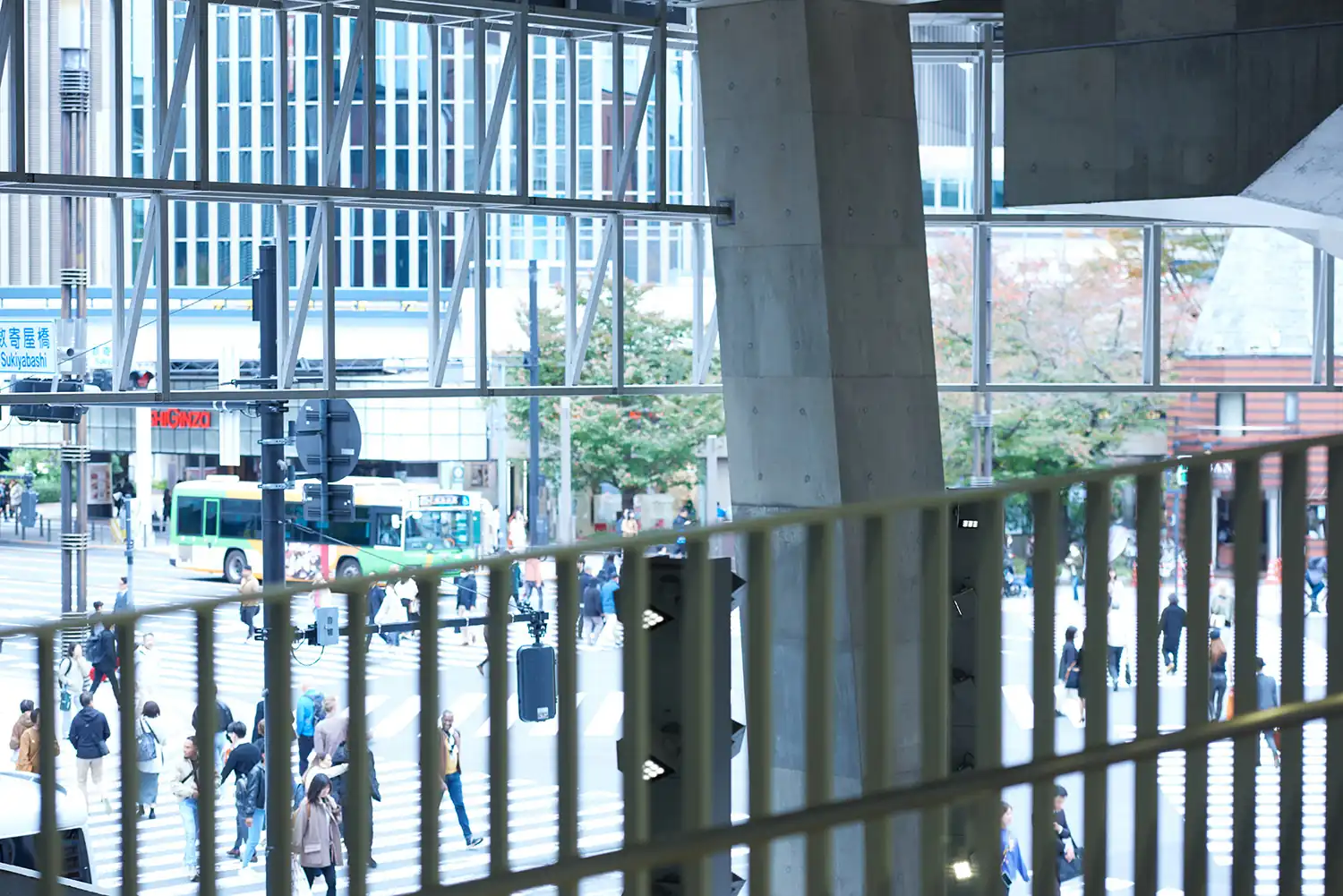
Nagano The concrete idea for this project started in 2013. Its predecessor, the Sony Building, was completed in 1966 and served as a landmark that became the entrance to Ginza from the Sukiyabashi intersection. However, almost 50 years had passed since its completion, and its reconstruction was being considered.
At the time, I was in charge of the domain of branding and design as a member of Sony’s CEO’s office, and I was assigned to participate as an observer in a meeting where the team considering the reconstruction reported progress to Kazuo Hirai, then Sony’s President and CEO. However, as I listened to the proposals from the members of the team, I felt that something was not quite right.
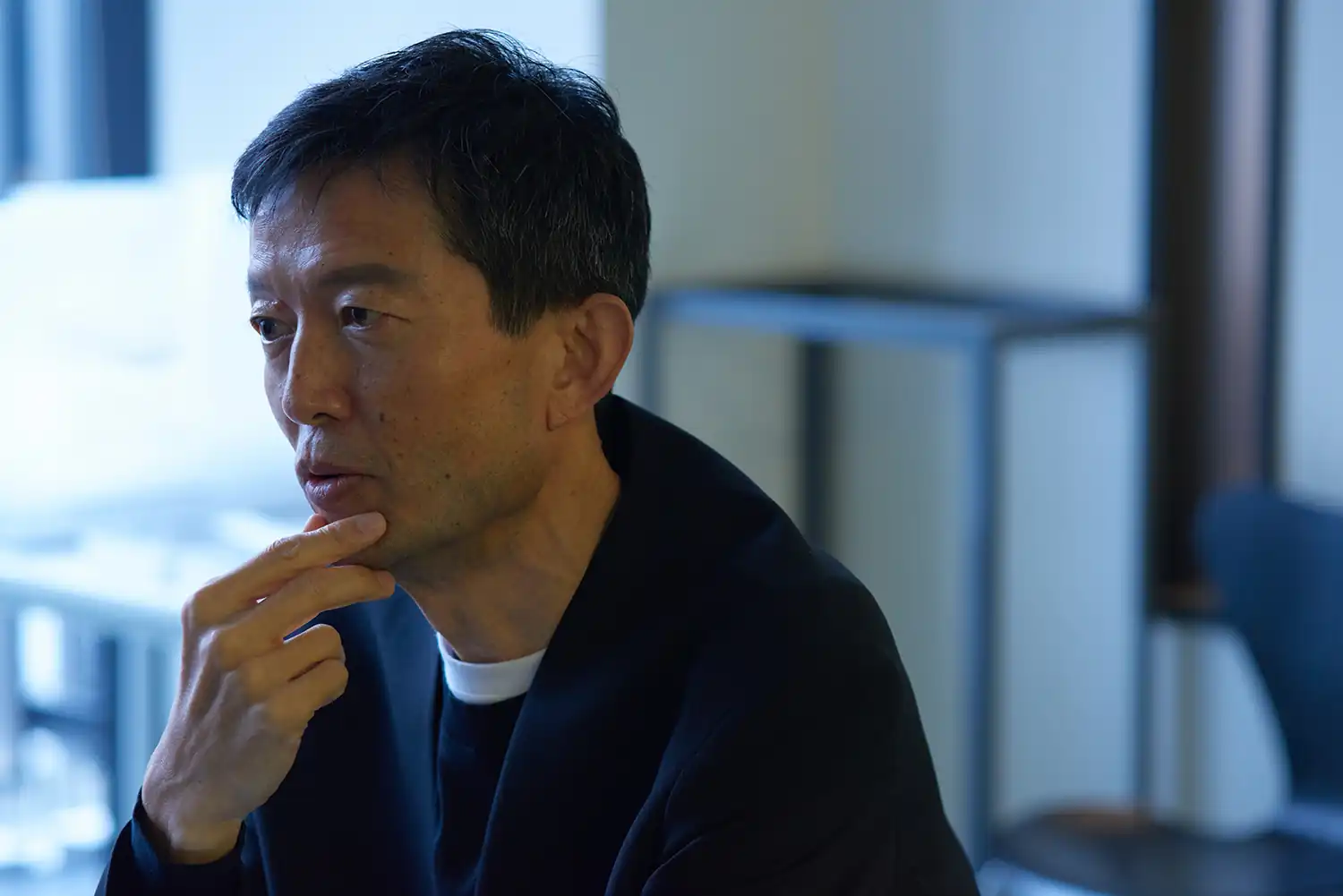
Nakamura “Not quite right”?
Nagano In short, I felt that it wasn’t “Sony-like.” This place is utterly unique ... It is a famous modernist building by Yoshinobu Ashihara, and it is also a place encapsulating the thinking of Akio Morita, one of our founders. I thought that if we were to rebuild it, we would need determination, a concept, and planning commensurate with this.
When I told Hirai about this impression, he said, “I thought so, too.” So I became involved with the project as one of the team.
Nakamura How did you think about the concept from that point?
Nagano At first, there was no concept or anything. We started with a blank sheet, thinking about whether the building should be left as it was, renovated, or rebuilt from scratch. There were three main pillars of the discussion. The first was economic value, the second was brand value, and the third was “the meaning of the place.”
At the time, in 2013, Sony was in a very difficult situation – we had hit rock-bottom. Looking back, in an environment where our existing businesses and real estate were being sold and our factories were being closed, it may have been a rather gut-wrenching decision to leave it unsold and start the process of rebuilding.
But if we had sold it, how would this have been reported? We were thinking about how the people with roots in this area who had loved the Sony Building over its nearly 50-year history would feel if the news bulletins announced its sale under difficult circumstances, the risk to our brand ...
Nakamura The issue touched the Sony brand itself, didn’t it?
Nagano Yes. On the other hand, responses to a survey about the Sony Building revealed that it could also be viewed negatively, as symbolizing Sony’s inability to change. At the time it was built, the complex came into being as Japan’s first multi-purpose showroom building and, as a hub for information transmission, became a symbol of Sony’s culture. But in the 2010s, our flagship electronics business slumped and for years we were unable to produce hit products like the Walkman® and PlayStation®. We could no longer place attractive new products in the Sony Building, our showroom.
Nakamura So the symbol of the poor condition of Sony was the slump in its electronics business, and the symbol of this was the Sony Building. The building had become one and the same as Sony itself.
Nagano That’s right. The Sony Building wasn’t just a building, it was Sony. It had become a perfect symbol. At the same time, however, was the fact that Sony’s business had grown considerably since the completion of the building, and the Sony Building alone was no longer sufficient to represent Sony.
Nakamura There’s a lot of research into symbolism in anthropology, and symbols are precisely what communities demand. Put the other way round, without symbols, you cannot build communities. How greatly are people’s emotions swayed by symbols ...? As long as people live, things and places are invested with certain meanings.
From “garden” to “park” – opening up the building to the public
Nagano That’s how we changed course towards rebuilding; but when that happened, the talk turned to architecture, such as how many stories we would build and what kind of use we would put it to. And so we came back to the same sort of mundane ideas that we had initially rejected.
As we discussed it again, trying to start from a blank sheet, the idea of “not building anything” came up. People laughed this off, saying “Uh uh, not building anything ...?” and “What will we do as a business?”, but after a few days, we began to think seriously about it, saying “Why don’t we try digging into this a bit?”
As I researched the meaning of the place and the thoughts of the founders and designers at the time the building was completed once more, I arrived at a breakthrough. This was the space of only 10 tsubo (around 33 square meters) called “Sony Square,” facing Sukiyabashi intersection.
They did things completely unrelated to Sony there in each season. They put tulips on display; they put up Christmas trees; they brought in sea creatures from Okinawa during the summer holidays ... Of course, they promoted new products from time to time, too; but despite being Sony’s land, it was open to the Ginza neighborhood. Morita called it “Ginza’s garden.”
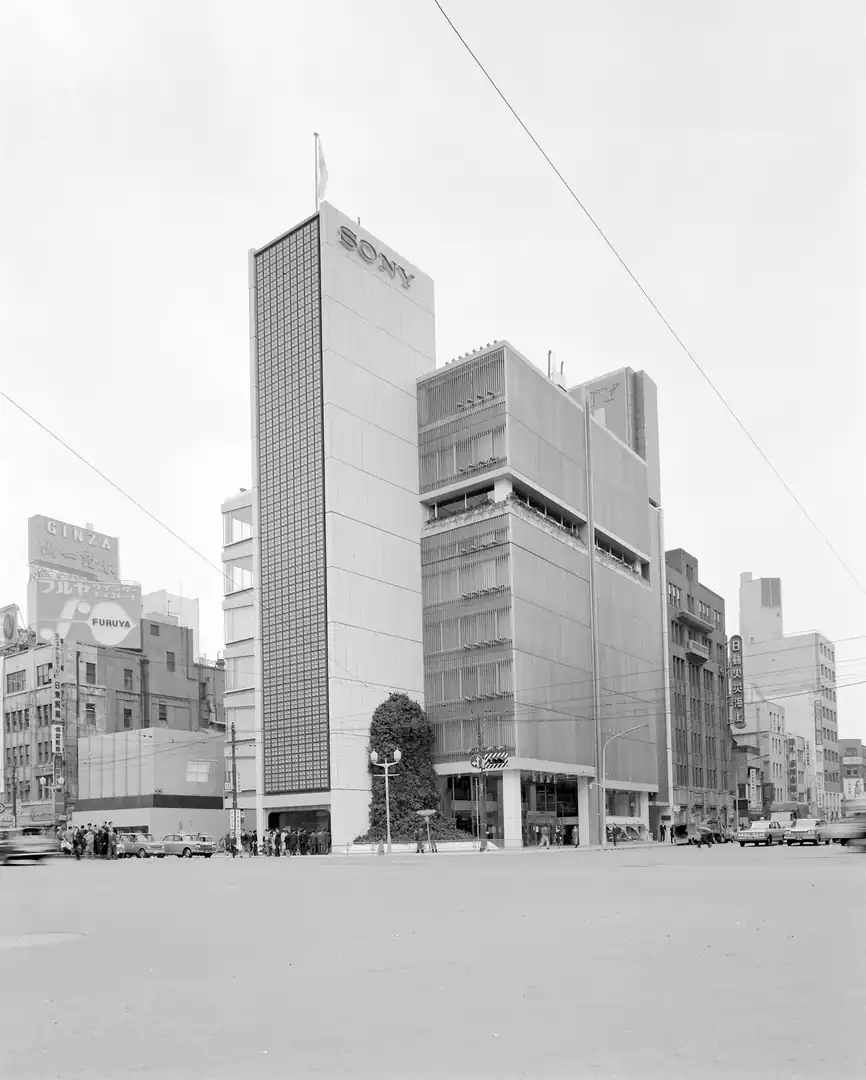
We have the idea of CSR nowadays, but in the midst of the high-growth era, I wonder where they had that leeway ... On a prime location in Ginza, it has functioned as a place for Sony to disseminate information, but in fact, the essence of the Sony Building is perhaps as “a facility open to the neighborhood.” I interpreted this as encapsulating the essential thinking of the founders and designers.
By looking at the question of “What shall we do with it if we don’t build anything at all?” in the light of this essential thinking, I came up with ideas like “If we don’t build anything, couldn’t we make Ginza’s garden bigger,” and “Somewhere bigger than a garden ... perhaps a park?” That’s how I came up with the idea of creating “Ginza’s park.”
However, “not building anything for a long time” isn’t interesting, either. I thought there was probably room for growth in its economic value, too, so I drew up a story in which the Sony Building would be demolished, left lying flat for a certain period of time, and then after this, rebuilt again.
Nakamura That’s the interesting point, isn’t it? You thought about it in phases, like the regular ritual rebuilding of Ise Shrine.
Nagano If we think about brand value, there are two kinds of novelty. One is the process. Rebuilding after turning the site into a flat park for a while is a process which no-one else has undertaken before. The other is the fact of making it into a park open to the public while simultaneously being the three-dimensional structure known as a building. We thought this would also be rare for an architectural structure.
Nakamura You didn’t make it into a park out of an awareness of the public interest right from the outset, did you?
Nagano That’s right. It simply ended up becoming a public space as the result of trying to carry forward the founders’ thinking and the designers’ intentions, that’s all. I don’t have a sense of having invented anything new.
Nakamura Looking at the founders of the big companies that underpinned the high-growth era and the entrepreneurs of even earlier times, I feel that many people had such a philosophy, even if they were not conscious of the public interest. Though not all of them did, of course. If we come into contact with the thinking of such people, who had a broad perspective and a grasp of things over a long time span, we may naturally end up at the public interest.
The brand value created by choosing rather “not to build”
Nakamura Did things progress smoothly after you decided to create a “park open to the public”?
Nagano The internal decision-making was perhaps relatively speedy. That’s because the project was under the direct control of the president, and so there were only a few layers of decision-makers. Moreover, they were unanimous about the direction of considering the thinking of those who built the Sony Building. I think that was lucky.
However, there were three main technical issues. The first was that the location is a “junction building.” It faces Harumi-dori, Sotobori-dori, and Sony-dori streets at ground level, and connects to the Tokyo Metro concourse and an underground parking lot, so it includes civic functions. That’s why we had to dismantle it with a proper understanding of the surrounding environment... but there was no plan for this anywhere.
Nakamura That was a gray area – perhaps we could say it was typical of the laid-back Showa Period ... (laughs)
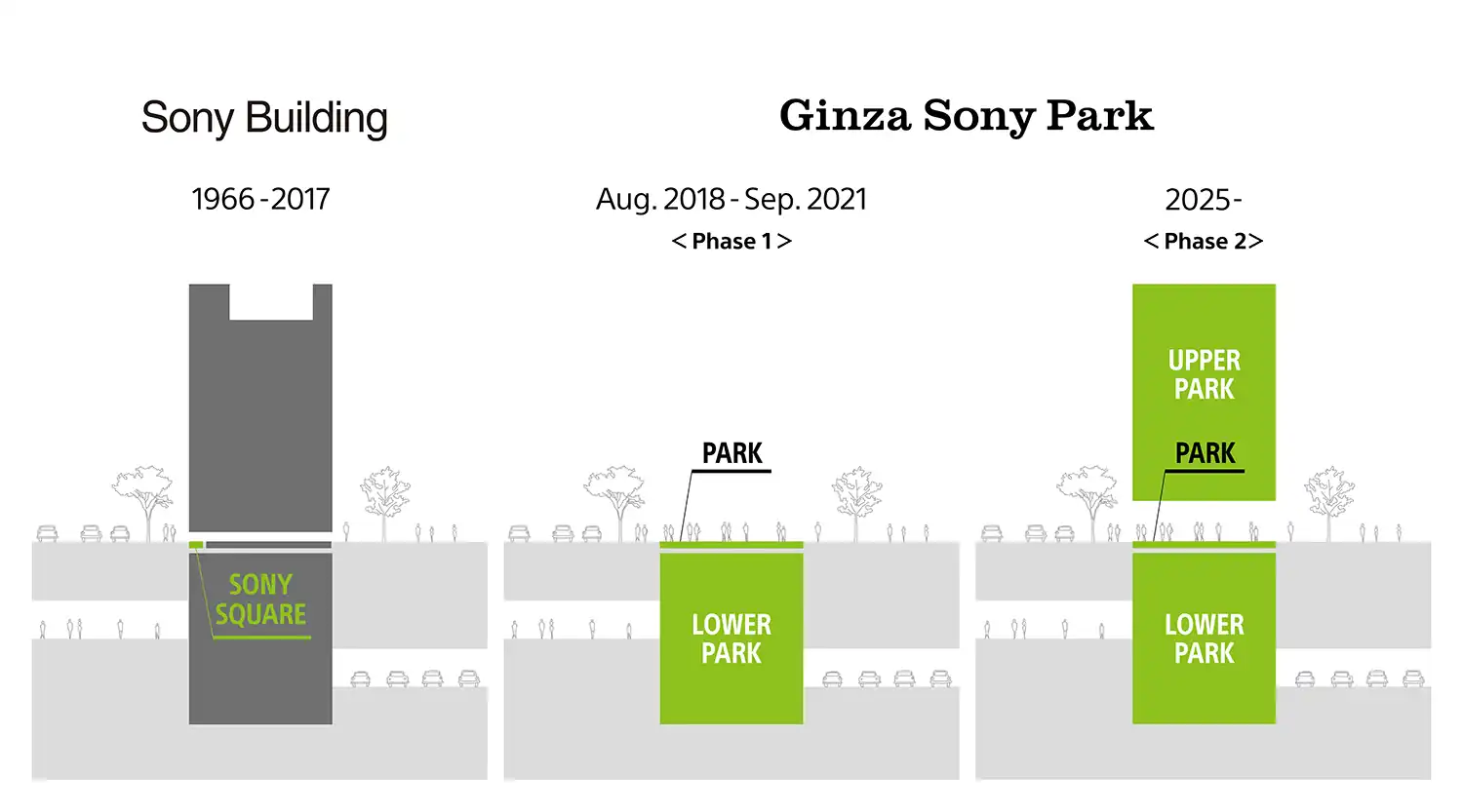
Nagano That’s right. The Sony Building and adjacent buildings were structurally connected. We worked with the Taisei Corporation, which built the Sony Building, but it was a rather difficult task to dismantle the building without affecting the surrounding environment. The second issue was related to this: the effects arising from “not building” a building. As a matter of fact, an underground stream runs through this area, and with the eight above-ground stories of the Sony Building no longer acting as a weight, there was a chance that it could rise to the surface due to buoyant force. In order to control this, we needed to create a balance by putting pig iron and sand into the deepest underground part to act as a weight.
The third issue was ensuring legal compliance. Even if we said that we would make it into a flat park during the reconstruction, the underground structure was left as it was. Under the Building Standards Act, it was very difficult to define the new building in a way that complied with the law in terms of aspects such as the change of usage or the interpretation of “renovation.”
Nakamura I myself am often involved in area management and community development, but what concerns everyone is how to ensure economic rationality. They say that they understand the meaning, but it’s hard for them to spare the resources. In the case of the Sony Building, when the building disappeared, the rental income would also disappear. How did you resolve such economic concerns?
Nagano There are a lot of internal checks regarding this point, so we planned it meticulously. Simply put, it was a structure in which income and revenue would decrease, but in return, “brand profits” would increase.
If the project were implemented, we would measure media exposure forecasts and ad conversion value, and also measure brand value by asking “What do you think about this initiative of Sony’s?” In this way, we developed a logic saying that if we converted “invisible value,” we could compare the value of constructing a park with the value of immediately rebuilding the building, leading to a positive result.
Nakamura You mean that short-term cash flow will decrease, but long-term brand value will increase.
Nagano That’s right. It’s a case of “Slow and steady wins the race” (laughs). Moreover, if other companies, including Sony Group companies, held events or promotions here, we would get a fee for usage of the space, so we could generate a certain amount of revenue even if there were no tenant income.
Nakamura Use even by Sony Group companies leads to income ...
Nagano We often get asked, “Can companies in the group use it for free?,” perhaps because they are holding Sony-related events, but that’s not how it works. Of course, if we want our group companies, too, to choose this location over other locations, we need to increase the value of this location and show them “reasons why they can only do it here.” Bryant Park in New York served as a good reference point. What I realized from looking at it was that parks need “blank spaces” and “programs.”
Bryant Park used to be unsafe, a place so dangerous that the public could not enter it. So they set up a managing body and started holding events in each season: a film festival in the summer, skating rink in the winter, and a market during the holiday season. There are also things like table tennis and chess there for people to use freely whenever they want. That’s how people started to gather there. As a result, a whole foods supermarket opened nearby, the offices of major companies moved in, and it came to be seen as an attractive area, creating economic effects such as higher rents in the surrounding high-rise buildings.
In Japan, people see parks as inevitably under the jurisdiction of the government, but while functioning as a park in the metropolitan area which is New York, this also contributes to the local economy as a business. We felt that this was a pretty ideal way of being.
The “blank spaces” and “programs” arrived at through experimentation
Nakamura I feel that your choice to keep the site of the Sony Building flat for three years rather than rebuild it immediately highlighted its presence; but how do you evaluate this?
Nagano What was good in the end was our ability to make a bold decision based on what we had learned through various experiments over the three years. The reason we decided to make the first floor of the building completely open was because more people visited the site during Phase 1 than had visited the Sony Building. As a result, the total construction costs were also cut by nearly half. I think that throughout the process, looking at things in total, it came out positively.
Nakamura Was there anything unexpected when you actually opened Ginza Sony Park?
Nagano There were many things! However, since we don’t clearly define what this place is for, we could say that everything is unexpected. It’s not that there aren’t certain rules, but basically everything has been left to the users. We want people to meet up there, take a break, attend an event by their favorite artist, or come for coffee: to spend their time as they please.
We are often told “This isn’t a park.” But parks are not only the stereotypical spaces with a certain area, lawns and benches, trees growing ... We thought that one of the essences of a park was “blank spaces.”
Nakamura You re-examined the definition of a park itself, right?
Nagano What was symbolic of this was a scene we saw during Phase 1. An elementary school student with a satchel on their back came to the basement floor and started doing their homework. After a while, their mother came and the two went off towards the subway station. They had probably arranged to meet here.
Nakamura I see.
Nagano Come to think of it, there is no other place in Ginza where elementary school girls can meet safely. Cafes cost money, and the nearby parks don’t keep off the elements. This was a way of using the place that we hadn’t envisaged at all.
Another interesting thing was a social media post in which a mother with small children praised Ginza Sony Park. She said that in nearby parks, there are unwritten rules for social interaction between mothers, making it hard to casually take her children out to play. Ginza Sony Park is free of such constraints, which means that you are left alone in a good way; at the same time, the staff are kind and it’s safe, so she was grateful for it.
Nakamura It’s a place where you can spend private time, despite being in the middle of the city with many people around.
Nagano Architect Fumihiko Maki said, “A public space is a collection of private spaces.” I didn’t understand that phrase when I heard it, but I have realized that this is exactly what is happening at Ginza Sony Park.
There are elderly men who read newspapers in the same place every day, young women who drink coffee, and elementary school children who meet their mothers there. In other words, it has become a private space for these people. The word “public” gives people an impression of uniformity, and we tend to think of it as something social, but if you break it down one by one, there is a private space for each person.
Nakamura That’s interesting, isn’t it? I’ve often heard stories that even when a public space has been deliberately created, people don’t gather there ... maybe this is what’s going on. What I felt while carrying out fieldwork in New York, indeed, and in cities in Europe and other places was that there are very few places in Tokyo where you can sit and relax. I think that the fact that you can’t even have a rest without paying for it leads to a feeling of discomfort. Given this context, it’s really amazing that you built a place like this right in the middle of Ginza.
Nagano I think Sony as a company has been creating such experiences for a long time, though. The Walkman made music to “listen to with everyone” into music to “listen to alone.” So it offered a private experience. And so it was a natural idea to be aware of private space even in a park. And the aggregate of these is “public.” I thought that as long as there were “blank spaces,” however small, it would be possible to achieve the “relaxation” that people are looking for.
Moreover, thinking about the meaning of the Ginza location, some people go there seeking out new information since it is a place with a high population density. Although they may have no specific aim, thanks to a “hunch” that they might find something interesting there coexisting alongside a “blank space” entrusted to them, a city park is formed. And so we need a “program.” An urban park in which people who have a purpose mingle with those who don’t ... that’s what we’re aiming at.
Ginza Sony Park, embodying the “cool” of Ginza’s streets
Nakamura Many people have recently come to talk about the indigenous character of each area, and I often wonder what the indigenous character of Tokyo and of Ginza is. This is my personal interpretation, but I feel that Ginza Sony Park is one of Sony’s responses to this.
Nagano Taking a bird’s eye view of the Ginza of today, I feel that it leans too far towards the “upper end” in terms of its branding. But if you go back in history, Western-style restaurants and bakeries were established after the Westernization of the Meiji Period, tailors appeared ... I think it was a more casual, start-up type of place.
Nakamura Yes, that’s true.
Nagano But somewhere along the way, these became long-established shops and traditions ... After the high-growth era, the Showa and Heisei Periods, it became an area “on the up and up” before anyone knew it. Of course, some people will be happy with the way that it has become high-end, but is that really good for the neighborhood? That’s my question. I think that neighborhoods should naturally be diverse. There are old shops and new ... I think it’s healthier to live in a living and breathing neighborhood where the high-end and casual intermingle, where people come and go as they please.
Nakamura Listening to you speak, it seems to me that you are thinking of the “culture” first and foremost: how will Ginza Sony Park affect the culture of Ginza as a neighborhood, as well as the culture of Sony? Of course, since you are a corporate entity, I think that you also keep business in mind; but I think that the order is to think about a system that will last for 5 or 10 years and then put this into an economic rationale.
Nagano The “culture?”... Maybe this is “whether or not it’s cool,” after all. When Phase 1 of Ginza Sony Park was first completed, the most frequent comment was that it made it easier to see Hermes.
Nakamura The building next door, right (laughs)? Since the above-ground floors of the Sony Building had gone, you could see it.
Nagano It’s still lower than other buildings, so you can glimpse the glass blocks through the gaps on the sides like a picture frame. It’s “borrowed scenery.” If we were simply pursuing economic rationality alone, it would be better to build a building right up to Ginza’s height limit and let tenants in. But we didn’t do this.
Nakamura That’s “cool”...
Nagano I think that Ginza has probably been a “cool area” ever since the Edo Period. The word 粋 (iki) is often translated into English as “sophisticated,” but the original meaning is closer to “punk.” After having properly understood the form, they dared to break it. There is a theory that the word emerged from the Edo aesthetic sense, as a counterweight to tradition and the region around Kyoto.
Sony has always been a company with this kind of culture, a counterculture. The Walkman, the PlayStation ... Ashihara, who designed the Sony Building, even wrote a book called “The Aesthetic Townscape.” It’s an “aesthetic.”
His sense of beauty and his spirit, pulling off things like Sony Square with ease regardless of what others said, have been handed down even to this day. This just happens to be a park, and the combination of branding and a business context helped many people see it as “cool” – I think this is probably the correct understanding of how we got here.
Nakamura The other day, I had the chance to meet with Yuko Tanaka, who studies Edo culture, and so I have just heard about iki, or “cool.” She told me that the culture of iki was an aesthetic sense around the time when the shogunate issued sumptuary laws prohibiting extravagance among the citizens. It was an attitude of trying to create something new even under these constraints, wasn’t it?
Nagano At the end of the day, I think it starts from a single person’s thoughts and ideas, like most things in the world. Perhaps we could call it luck and fate that a person such as I joined Sony and got involved with the project at that time. There are things that have been handed down in this place for about 50 years, thanks to Sony’s track record and the ideas and intentions of Morita and Ashihara. These were not exactly the same, but they overlapped bit by bit, and by maximizing that overlap, you get something unshakeable.
Nakamura There is a history that has accumulated until now, isn’t there?
Nagano But having said that, something that everyone likes will probably become boring the moment it’s built. It’s scary to be criticized, isn’t it? But if you shy away from this and go for overall optimization, only ordinary things will emerge.
In the end, I think it’s down to whether or not each person has strong ideas and can realize these, and whether or not the team as a whole can share such an understanding. When it was completed, the president said, “No other company can copy this. Because you created it without obtaining a consensus,” but I interpreted this as a compliment (laughs)!
Nakamura It’s about not being afraid of criticism, isn’t it? The theme of the 2025 GOOD DESIGN AWARD was “A Small Step, Design Leaps,” in which the passion of an individual gets others involved and sets big things in motion. I am made to realize once again that this design embodies exactly that.
Leaving things up to the thinking of others – a platform that continues to change
Nakamura What do you envision for Ginza Sony Park going forward?
Nagano I don’t know how long I’ll be in this position, but first of all, I want to start doing various things to increase the value of this place in the next three to five years. And when it comes to 10 or 20 years down the road ... Someone else will probably be in charge, and so I have to leave that up to them. I think this is what it means to have “blank spaces.”
If the Sony Building was a flip phone, Ginza Sony Park is a smartphone, a platform. Having blank spaces means that it can respond to each era. If they want to proceed with a different way of thinking from mine at any given time, I will leave it up to them. All they have to do is install the apps they need and keep on changing. Embrace various things, let various things pass by. I think that is a blank space, the urban type, a junction building.
Nakamura The way of thinking that understands the site as having a symbolic function epitomizes Sony, doesn’t it?
Nagano I think that it would be great for this kind of thing to become more standard, not limited to Sony. Just the other day, Mitsubishi Estate announced that they would create a temporary square during the redevelopment of the area in front of Yurakucho Station.
Nakamura Yurakucho Park, right?
Nagano Instead of tearing down a new building and rebuilding it right away, turn the area into a park for a while. If we did this, I think that there would be more parks in Tokyo. I might venture to say that it would be good if the government were to back this up more. There could be a property tax exemption, or the floor area ratio of the new building could be increased, if you put an interim period in place ... If this kind of legal backing were to follow, I think that the appearance of the city would probably change even further.
Daisuke Nagano
Joined Sony in 1992. After working in areas including sales, marketing, management strategy, and the CEO’s office, he took up his current position in 2017. He led the Ginza Sony Park Project from 2013 as project supervisor, opening Ginza Sony Park in its final form in January 2025.
Yutaka Nakamura
Anthropologist, professor at Tama Art University, representative of Atelier Anthropology, KESIKI Inc., design anthropologist and cultural anthropologist
Design anthropologist. Professor at Tama Art University’s Liberal Arts Center. Representative of Atelier Anthropology LLC. Responsible for insight design at KESIKI Inc. At the same time as working on research topics such as the social design of violence and violence reduction on the “edges,” he has also been involved in social implementation together with a variety of companies, designers, and managers. At Tama Art University, he leads the Circular Office and Tama Design University’s Division of Design Anthropology. He has authored books including “Walking on the Edge of America – Anthropology of Travel” (Heibonsha, 2021) and “Echoes of Harlem – Voices of Muslims Living on the Streets” (Editorial republica, 2015).
Sachiyo Oya
Writer
Born in Ehime and grew up in Gunma, Tokyo, and Fukuoka. After graduating from Ritsumeikan University, she worked at Seibu Department Store and a production company before becoming a freelancer in 2011. Having worked in Kagoshima, Fukui, and Ishikawa, she is now based in Tokyo and writes and edits mainly in the domains of business, design, and the local area. Author of “Kagoshima Cafe Stroll;” editorial collaboration on “Let’s Cut Sales” (Akemi Nakamura), “Stand Out from the Crowd” (Takaya and Fumito Matsuda), “Minority Design” (Tomohiro Sawada), “How to Change Society” (Fusaho Izumi), and more.
Shunsuke Imai
Photographer
Born in 1993 in Minamiuonuma City, Niigata Prefecture. After working for amana Inc., he went independent.
Masaki Koike
Editor
Editor. He carries out planning and editing in multiple media, mainly in collaboration with researchers and creators.