
To the place where "good design" was created
Good design, excellent design, design that opens up the future, ideas that move people's hearts, and actions that lead society always have small beginnings.
Interviews with designers at the birthplaces of good design to find hints for the next design.
Destination
Kouhoku Rubber Co., Ltd.
Creating possibilities from “black rubber” (Part 2)
2026.11.6
Eggshells, tea, seaweed, wood, stone, iron. “Rebbur” incorporates materials that had never before been associated with rubber to create new looks. In the background to this is the blending technology that Kouhoku Rubber Co., Ltd. has cultivated over many years. So how is rubber made in the first place? As we walked through the factory, we could see a manufacturing process different from that of plastic: applying heat, causing chemical reactions, and molding. Following on from Part 1, we asked President and Representative Director Kenta Sugahara and designer Tomoki Doi about the characteristics of rubber as a material, the new encounters that Rebbur opened up, and Kouhoku Rubber’s aims for the future.
Try straying away from the correct route
– In Part 1, we heard how Kouhoku Rubber’s strength lies in your ability to blend rubber to match the end use, making everything from materials to products. How do you actually make rubber products in your factories?
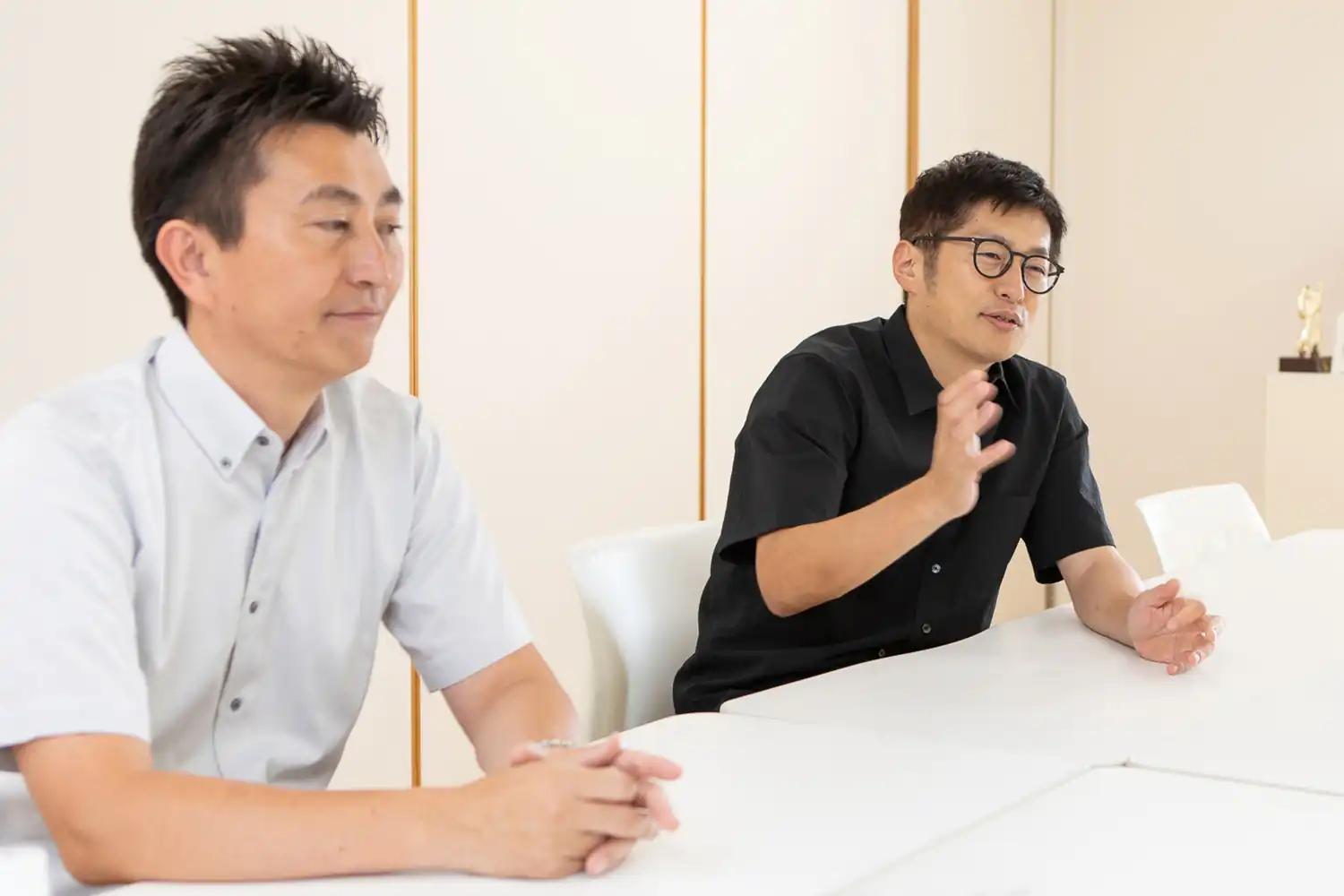
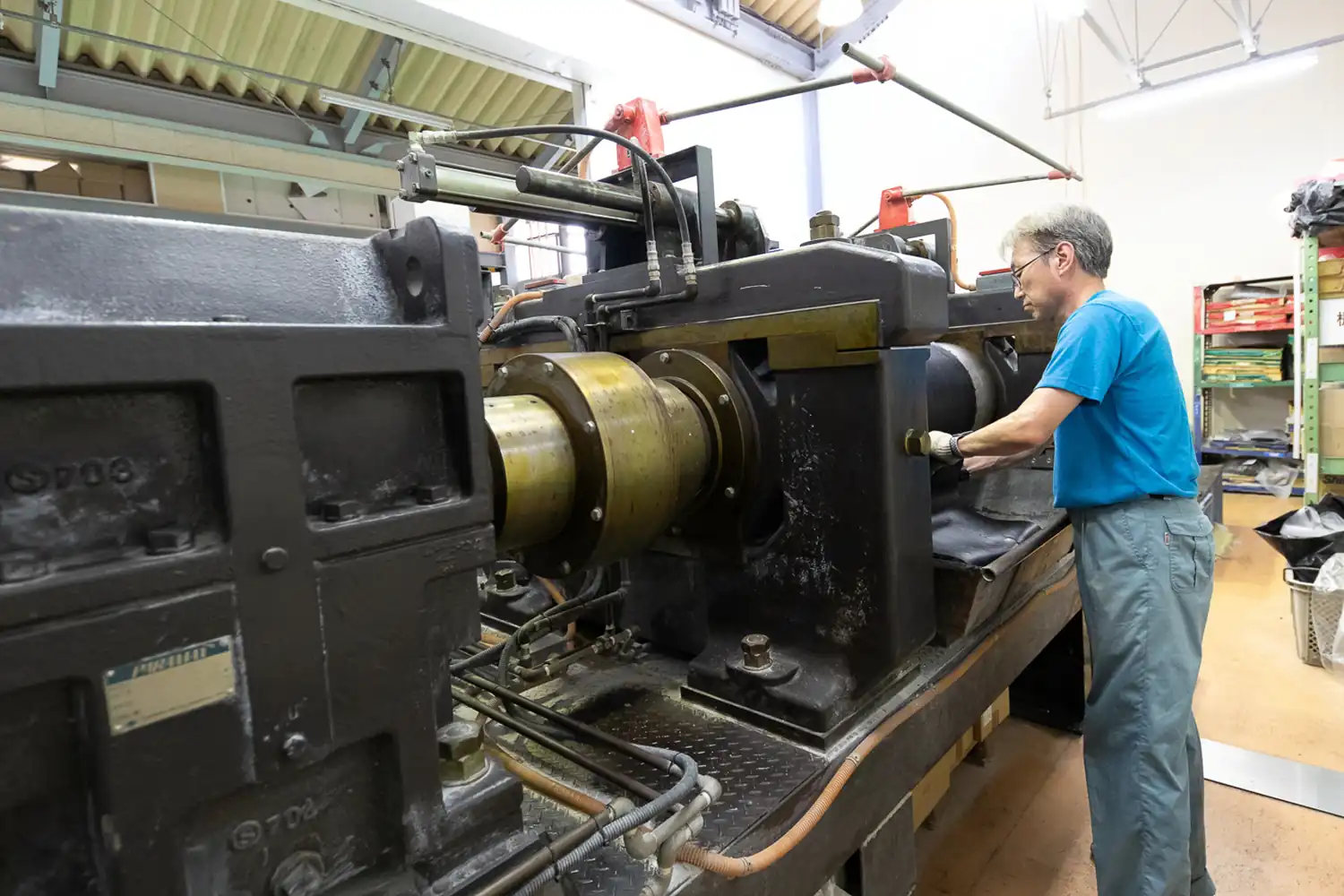
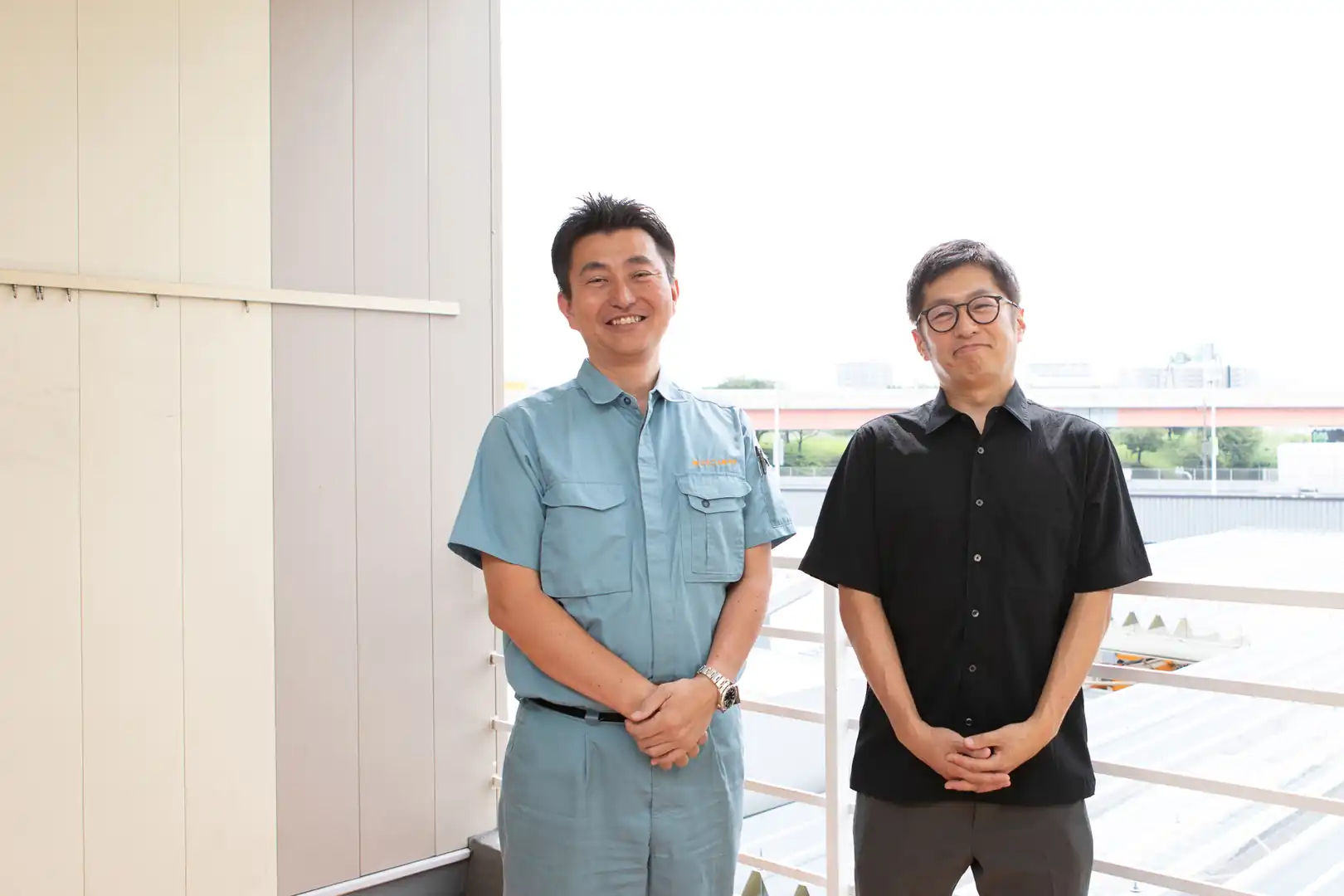
Kenta Sugahara (President and Representative Director, Kouhoku Rubber Co., Ltd.) Rubber is made by applying heat to trigger a chemical reaction. The metal mold is heated to about 160 or 170 degrees Celsius, and the material is poured into the mold and pressed to cause the reaction. Ordinary plastics are “thermoplastic,” meaning they melt with heat and harden when cooled. So you can make one item after another, in the space of a few seconds. With rubber, on the other hand, you make the material react chemically by applying heat, so it takes several minutes, or even tens of minutes depending on the item.
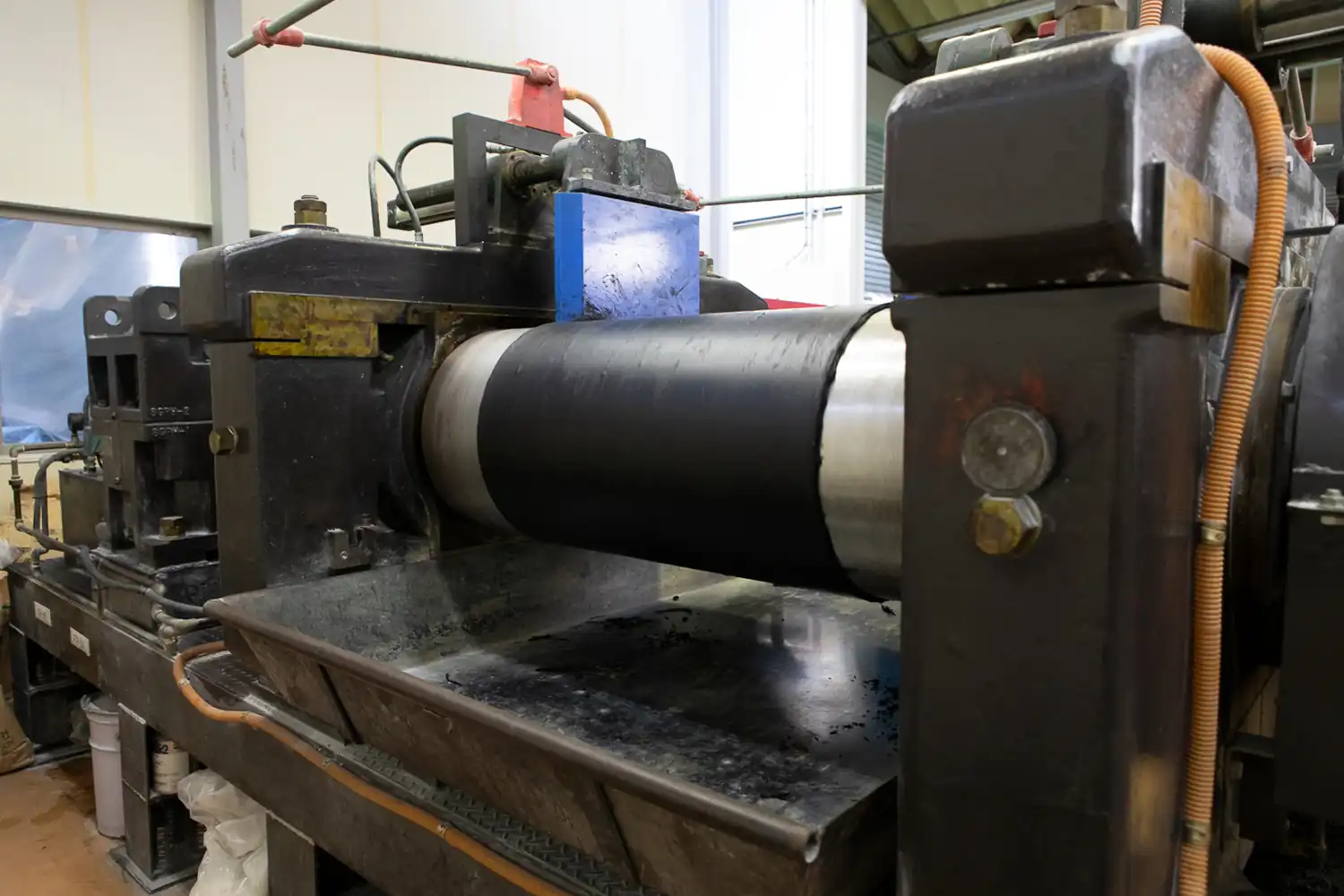
– I got a chance to actually see around the factory, and it’s pretty hot, isn’t it?
Sugahara Yes, it’s hot! Summer is particularly tough. The mold itself gets that hot, so everyone is doing their best to work in that heat.
– Is there also a difference in the ways rubber and resins are molded?
Tomoki Doi (Representative and Designer, Soell inc.) Yes, there is. When molding resin with a metal mold, it needs to be at an angle to be pulled out from the mold, but rubber can be pulled out without being at an angle. That’s because rubber changes its shape.
Here, too, we put in air and pull it out. I think there are shapes that can be made with rubber, thanks to these traits, and costs that can be reduced.
– Things that you can do because rubber changes its shape, right? So to start off with, what are the special characteristics of rubber?
Sugahara That’s difficult... What’s rubber (laughs)? To put matters simply, it stretches. It stretches and then returns to its original form. That’s rubber. Because plastic doesn’t stretch.
For example, it isn’t something we make at our company, but if we didn’t make the tires for jumbo jets out of rubber, what would we make them out of? When a jet lands, there is a tremendous impact. Iron is no good; plastic is no good at all. The tires have to absorb all that impact and withstand all that wear.
When you think about it in this way, there are many things that only rubber can do.
– Is Rebbur a material that makes the most of these characteristics of rubber?
Doi Rebbur has different materials mixed in, so it doesn't really make much use of the characteristics of rubber in terms of “stretching and bouncing back.” However, it is nonslip and cushioned, and is not easily broken or damaged even if it is handled quite roughly. I think that these are positive points of rubber.
But I think that what makes Rebbur interesting also lies elsewhere. The blending technology developed up to now by Kouhoku Rubber is fundamentally to improve the functionality of rubber. Industrial rubber, such as gaskets and black rubber sheets, must first of all be sure to demonstrate the necessary capabilities. There's not a lot of emotionality there, is there?
With Rebbur, we're experimenting to see what happens when we take this blending technology we've developed to improve functionality and use it on what you could say is straying away from the “correct route.” The look created is different from that of conventional industrial rubber in terms of both color and texture, because whatever has been mixed in can be seen. I don't think there are many companies doing anything like this.
– Is it about changing what you aim to do, even with the same technology?
Doi Yes, that’s right. We also receive requests to use the material from companies that find it interesting. In these cases, it is not necessarily simply about solving a problem; it is also about thinking about a rubber that will not seem out of place in everyday life, or a rubber that is different from those in the past.
Another thing we can do is to mix in the company’s waste products and turn them into Rebbur. Changing waste produced by a company into a material for that company. By doing this, the story of the company is added to the material itself. Developing Rebbur in the form of our own products and having other companies use it as a material: I think that these are the two directions for us.
The sense that foreign bodies are present becomes the look
– There are six types of Rebbur materials at the moment. Will you be adding more types?
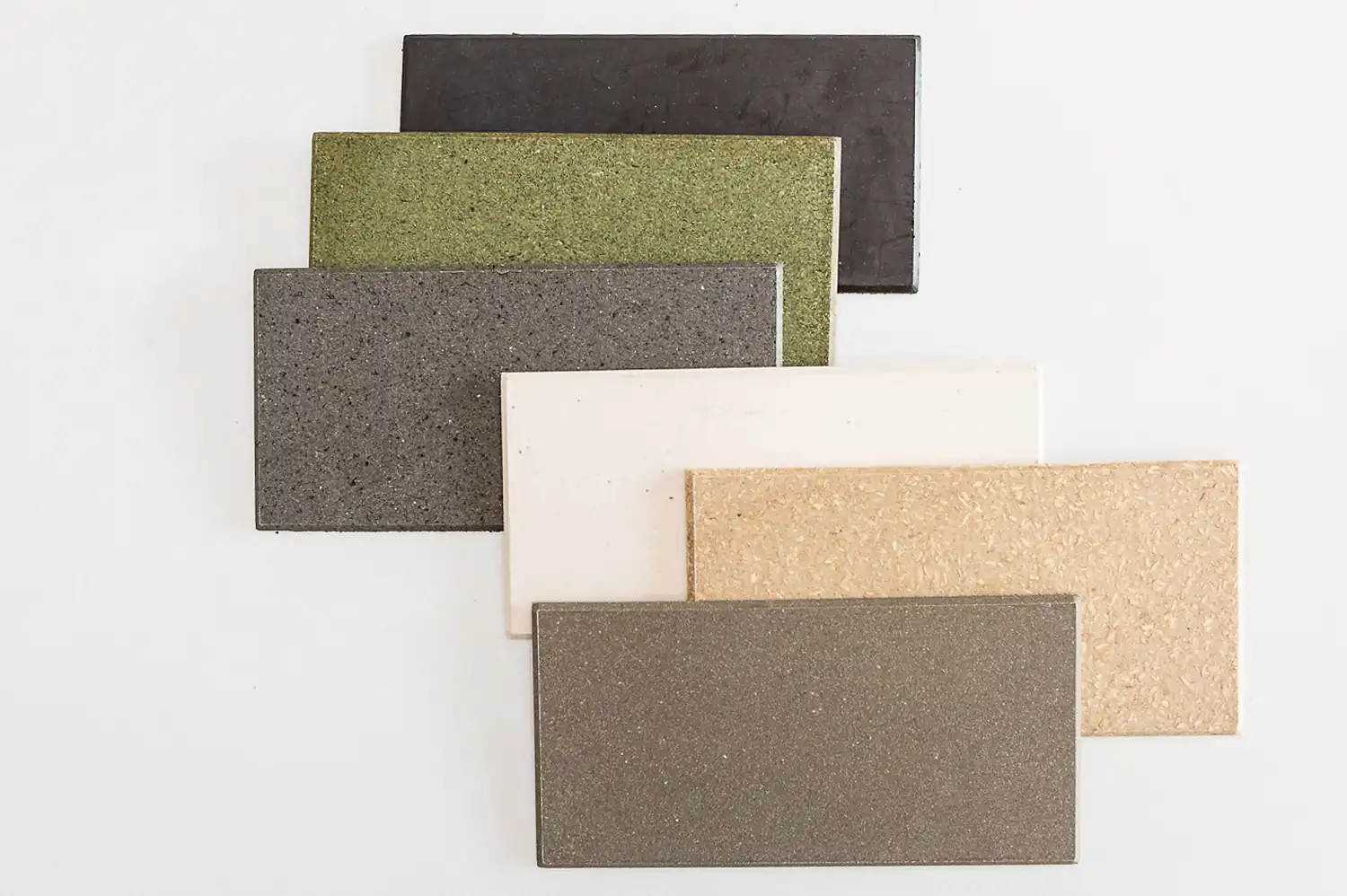
Doi If we aimed to increase the number, I think we could do various things and have 10 or 20 types. But if we add too many, they will end up scattering. In the future, I think it would be better rather to narrow down the types a bit, dig deeper into things that work well together, and create collaborative products using them.
– You’re attempting to move beyond the stage of showing that you can mix anything, aren’t you?
Sugahara For example, eggshells were initially ground finely and then mixed in. That’s because they are easy to mix in that way, and the sense that foreign bodies are present disappears. But when we tried kneading in somewhat larger pieces, we found that they became the look. If the brown shells of brown eggs are mixed in, they show up as speckles.
– You are taking the sense that there are foreign bodies present, which you would try to get rid of with industrial rubber, and instead making use of it.
Sugahara That’s right. In our business-to-business work, we have always pursued functionality: high functionality, high quality, and longevity. But with Rebbur, we think it's okay to loosen the screws a little bit and change the way we've always thought about things, saying “Maybe it’s OK even if it doesn’t last quite as long.” We’re trying to change direction a little, while retaining the good aspects of rubber.
The reaction from overseas
– Rebbur has been exhibited overseas, too, I hear.
Doi Yes. We have exhibited the material at Milan Design Week, and in the Netherlands. There are many people overseas who are interested in such efforts to put waste materials to use. A German who saw Rebbur in Milan went on to visit Kouhoku Rubber’s factory. When we exhibited in the Netherlands, too, we received a lot of inquiries.
– Did that person come all the way to the factory in Japan after seeing your exhibit?
Doi Yes, that’s right. It doesn't mean that anything big will change right away, but I feel that Rebbur is gradually expanding and the possibilities are increasing. I hope that by building on these points, the value not only of Rebbur but also of rubber itself as a material will become more widely known among the public. If the company can expand its business to the extent of being able to approach the overseas market, I’d like to help with this.
– Mr. Doi, did you know much about rubber yourself before you started working with Kouhoku Rubber?
Doi I didn't know much about it at all. Quite simply, I got involved because it seemed interesting. Although rubber is a material that everyone knows, I think that maybe surprisingly few people have thought about natural rubber or synthetic rubber in depth. Rubber is something that we cannot live without, but it is something that we do not know about, even though we think we do.
So I think there might be a new way of being for rubber there, a new way of existence. It's very interesting.
Contemporary design is about giving shape to ideas
– Have the two of you continued to work together since the development of Rebbur?
Doi Yes. We are always in touch with each other, talking about taking part in exhibitions, and thinking together about what we can do in response to inquiries from customers about a particular kind of material they want to make. We also discuss how to market the products and what kind of companies might be interested in this initiative.
Of course, we sometimes design necessary things, such as brochures, but that's not all. How will we expand Rebbur’s reach? In which direction will Kouhoku Rubber go? I have expertise in a different field, so I share it as we think together.
– This is quite different from the typical relationship in which you “have a designer design your product,” isn’t it? Mr. Sugahara, in what way do you feel the power of design while working with Mr. Doi?
Sugahara I think design is more about giving shape to your ideas than it is about doing something that has design as the focus. At the outset, there is something we want to do; we think that we want to go in a certain direction. But sometimes it's still vague. I mean, design is something to make that a little bit clearer.
If you’re groping and floundering around, it’s hard to see a way forward. So it gives you a little boost, and a vista opens up. I hope that we can have that kind of relationship.
– It's important for companies to express their ideas first, rather than asking designers to come up with an answer, and then work together so that the goal becomes visible, right?
Doi Yes, that’s right. Of course, there are also cases where companies find new opportunities because designers have created something. However, it seems to me that the kind of relationship in which companies know what they want to do and where they want to go, like Mr. Sugahara does, and designers think how they can support this matches our current era better.
From a material that gets no credit to a company to be proud of
– What kind of company are you aiming for Kouhoku Rubber to become?
Sugahara I say “Rubber has endless possibilities,” but I think that this is not only true of rubber. Everyone working here can expand their potential as humans as much as they want. If we say, “I can't do that,” growth stops there, so I believe that how we think about ways we could do it is important.
Sugahara I don’t just want to do what I’ve been told to do – I want to create surprise and enjoyment that go beyond these expectations. It's easy to say, “Let's go above and beyond,” but it's hard to actually do it.
– What kind of future do you envision beyond this, 10 years from now?
Sugahara I want us to be a company that customers all over the country can rely on. We find it fun to roll out things that are different from other companies, a bit odd, and even get asked to get involved with national government projects out of the blue.
I also want to do work that allows rubber, which has not got any credit for its role in the past, to break out of this box and become the main player. And I want to make it a company that the people who work for us can boast about to their families. That’s the kind of future I see.
– Rebbur is one of your initiatives towards that future, isn’t it?
Sugahara That’s right. In business-to-business jobs, we’re really good at doing what we’ve been told to do. When people consult us about a problem they're having trouble with or when we get a blueprint, we’re very good at giving it a form.
But I think that making things from scratch will also be necessary going forward. I want us to become an organization that not only makes the things others tell us to make, but also can think about and make things starting from zero. And I don’t want to be doing these things as the president. I want to make our company as a whole able to do this.
– Have you also thought about a structure for this?
Sugahara I want to set up a development division as soon as I can. I want to create a system where employees can think up and develop products by themselves. But in order to do that, they have to sell (laughs).
– Thank you very much! Kouhoku Rubber Co., Ltd. and its president, Mr. Sugahara, explore new possibilities for rubber while confronting immediate responsibilities and challenges of running an SME. And Mr. Doi who, as a designer, brings a fresh angle to these ideas and broadens the possibilities. We need to keep a close watch on their endeavors going forward.
Rebbur raw material
Kouhoku Rubber Co., Ltd.
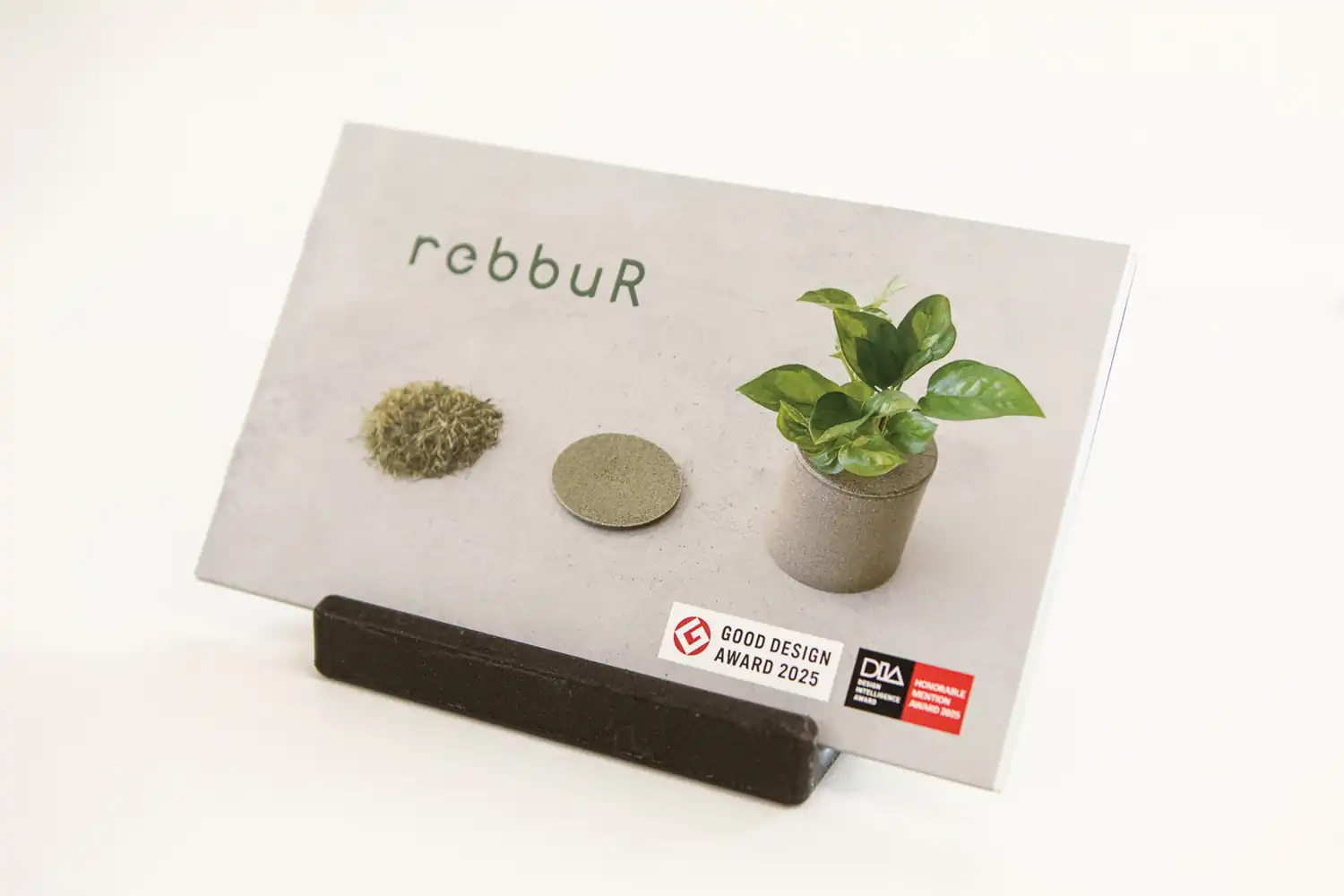
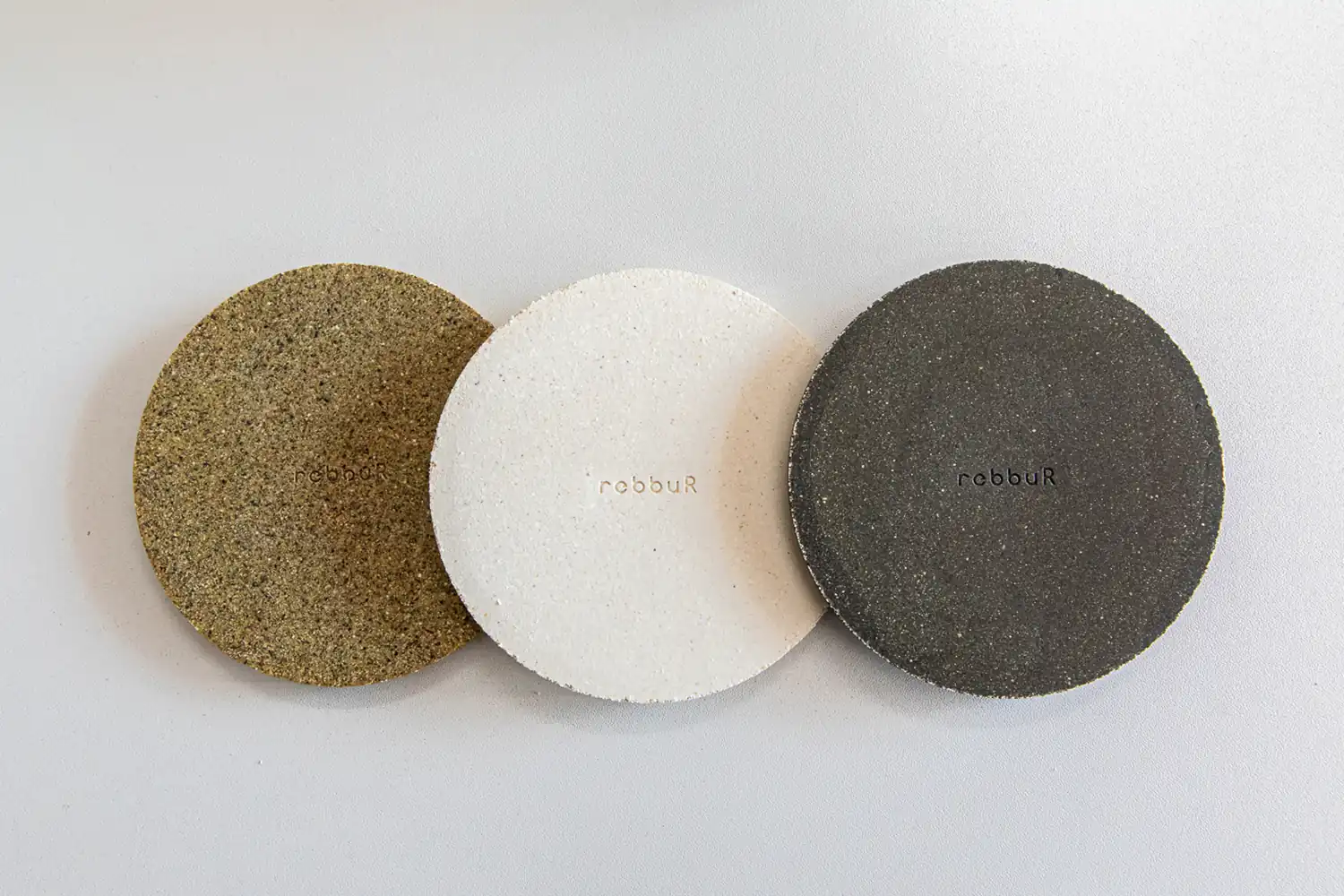
Rebbur is a new rubber material developed by industrial rubber manufacturer Kouhoku Rubber Co., Ltd., in collaboration with designer Tomoki Doi and others. Combining unused materials such as eggshells, tea, or dried seaweed with natural rubber makes the most of the color, fragrance, or texture of the materials themselves. The blend of approximately 70% unused materials and 30% natural rubber maintains the flexibility of rubber while producing different expressions and characteristics depending on the materials mixed with the rubber. The company is also looking for ways to expand applications through combinations of materials, such as by blending in iron powder to make the result magnetic. Not only does it reduce waste, it also points to unprecedented value and potential for rubber.
- 受賞詳細
- 2025 GOOD DESIGN AWARD https://www.g-mark.org/en/gallery/winners/33752?years=2025
- Designer
- Tomoki Doi
Tomoko Ishiguro
Editor/writer
After working in the editorial department of “AXIS,” she became a freelancer. She writes, edits, and plans, with a focus on design and life culture. Her major editorial works include the LIXIL BOOKLET series (books, LIXIL Publishing) and “Oishisa no Kagaku” (magazines, NTS Publishing).
Chieko Shiraishi
Photographer
She started photography after taking a black and white enlarger course organized by her town. After working as an assistant photographer, she is now mainly active in taking photos for magazines and other media, while also creating works in her darkroom.


Related Articles
Creating possibilities from “black rubber” (Part 1)
What comes to mind when you hear the word “rubber”? Tires, rubber bands, gaskets...? In reality, rubber is used to support society even in places where we do not see it. Kouhoku Rubber Co., Ltd., which has been in business for more than 60 years, has continued to produce rubber products tailored to specific uses by blending raw materials according to the needs of its customers. Kenta Sugahara, the third-generation company president, began looking for new ways of using it, saying “Rubber has endless possibilities.” These experiments gave birth to Rebbur, which combines unused materials such as eggshells and tea with natural rubber. Do not make something because there is a large market. First of all, give it a try. Search for the possibilities for new work from there. We asked Sugahara and designer Tomoki Doi, who is developing it together with him, about the kind of manufacturing that a small company can do best.
Beyond the company’s activities is society(Part 2)
“Infrastructure Stand” in Tokorozawa City, Saitama Prefecture, is a public toilet as an extension of the showroom. Mr. Daigo Ozawa, CEO, Ishiwa Plumbing Ltd., says that he started with “a business strategy with an eye to the company’s future.” In the first part, we introduced the Infrastructure Stand as a gathering place for people, and the process in which the activities of the Infrastructure Stand spread to the community by involving companies and the government. What Mr. Ozawa is looking at next is disaster preparedness and toilet issues. The Infrastructure Stand is now not just a public toilet, but is about to become a testing ground for a closed-loop toilet that can function even in times of disaster.
Beyond the company’s activities is society (Part 1)
A plumbing company that built public toilets – you may imagine that this is one aspect of contribution to the local community, or a corporate social responsibility project. However, the “Infrastructure Stand” developed by Ishiwa Plumbing Ltd. of Tokorozawa City, Saitama Prefecture, is a bit of a different story. This project, which began with an extremely unique attempt to build a public toilet as an extension of their showroom, was also a business strategy with an eye to the company’s future: in the words of CEO Daigo Ozawa, “This is both a publicity tool and a recruitment tool.” After taking the company’s activities to their utmost limit, a place in which people come together is born, and the scope eventually broadens to encompass community and disaster preparedness, all while drawing in private enterprise and government. Rather than trumpeting their social contribution in a loud voice, the next step beyond the company’s activities is society. We asked about how this was put into practice.
Designing agricultural heroes (Part 2)
“Saga Agri Heroes”: introducing design to agriculture, supporting the producers to build their own brands. This original initiative won a GOOD DESIGN BEST 100 award in 2022. In Part 1, we introduced Saga Prefecture’s mechanism for incorporating design into local government and supporting the brand development of farmers by accompanying them over a long-term period of four years. In Part 2, we explore the challenges faced in the second phase, which is currently underway (2023-2026), the differences from the first phase, and the ways in which design is changing people and local communities.
